
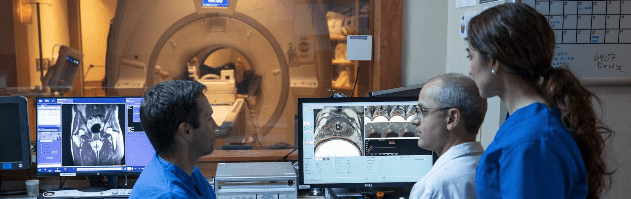
What is ExAblate?
ExAblate Prostate is a cutting-edge treatment option for prostate cancer that utilizes trans-rectal MR-guided prostate ablation. It delivers up to 1000 targeted ultrasound waves to heat and ablate prostate tissue with no surgical incision or radiation.
The treatment process is guided by MR imaging, allowing for patient-specific planning, real-time temperature monitoring, and immediate confirmation of treatment outcome.
At Stanford, a team of radiologists and urologists who are experts in MR guided focal therapy collaborate on the treatment day to provide this innovative procedure.

Benefits of ExAblate
- No incision, no radiation treatment
- Personalized treatment plan for each patient
- Focused approach using MR imaging
- Precise ablation with continuous monitoring during treatment
- Tissue-sparing technique preserves healthy tissue and reduces side effects
- Lower risk of erectile dysfunction/urinary incontinence compared to surgery or radiation
- One-session, outpatient procedure
- Short recovery time permits rapid return to everyday life
- Minimal or no pain
- Can be used when other treatments have failed
Are you a good candidate?
Patients with intermediate-risk prostate cancer are the ideal candidate for focal therapy with MRI-guided high-intensity focused ultrasound, such as ExAblate. The location of the lesion should be visible on MR imaging, preferably in the posterior or lateral portion of the prostate. The overall size of the prostate should be small to moderate, with no major calcifications or large cysts. It is important to inform your doctor if you have a history of inflammatory bowel disease involving the rectum, prior rectal surgery, urethral structure, or active infection. A prostate CT, prostate magnetic resonance imaging (MRI), and a targeted prostate biopsy are necessary for evaluation.

What you can expect
Consultation
Your physician will assess your specific case, considering factors such as the stage and location of the cancer, your overall health, and your treatment goals to determine if ExAblate is an appropriate option for you.
ExAblate procedure
ExAblate Prostate is typically an outpatient procedure generally performed in a single session.
Follow-up visits
Regular follow-up visits with your healthcare team are crucial to monitor your recovery, evaluate treatment effectiveness, and address any concerns or side effects. Your doctor will provide specific instructions regarding follow-up appointments.
Recovery and return to activities
Patients can quickly return to their daily activities within a few days following the procedure.
FAQs
ExAblate is performed in the hospital as an outpatient procedure. Patients are typically discharged from the clinic on the same day as the procedure, depending on the doctor’s assessment.
The procedure is performed in a single session that takes a few hours (4-6 hours). It is conducted under general anesthesia, therefore patients are required to have a ride to and from the hospital.
- Patients typically experience little to no pain after the procedure. Any discomfort is treated with over the counter pain medications
- Our team will provide close follow-up during your recovery.
- Patients are encouraged to have a friend or family member assist them for the first 24-48 hours after the procedure.
- A urinary catheter is placed for 1 weeks after your procedure. The physician will assess urinary function to determine the appropriate removal date.
- Blood in the urine may be seen temporarily in the weeks after procedure. Approximately 1 in 10 patients may
develop a urinary infection requiring antibiotics.
- Within days to weeks after the procedure, patients are able to resume their previously active lifestyles